
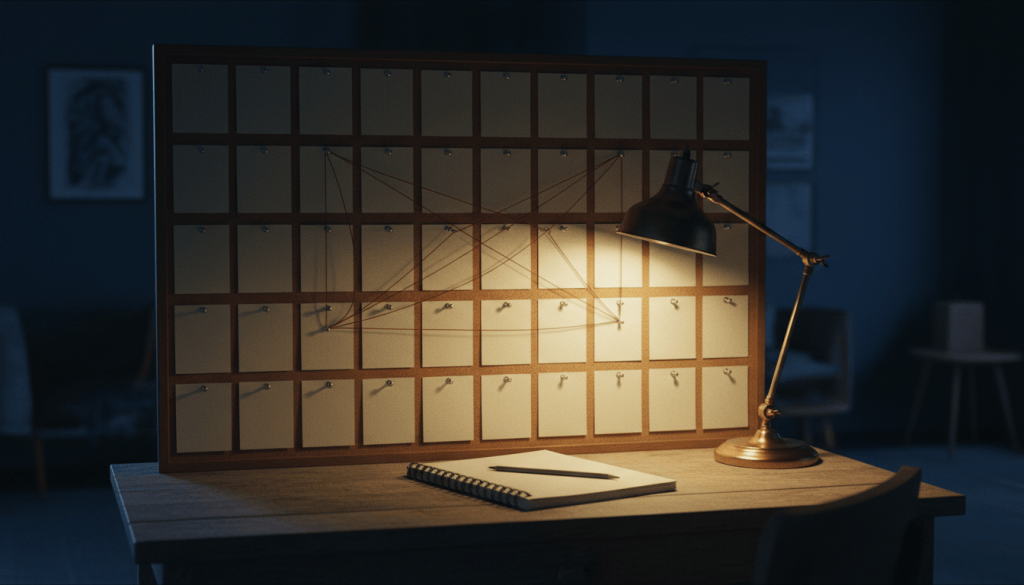
How to outline a screenplay is the question that sits between a good idea and page one. An outline is a plan of the story, sequence by sequence and scene by scene, written before the draft. It lets you find the problems while they are still cheap to fix: a middle with nothing in it, a character with no reason to act, an ending that does not land.
This guide covers a six-step method, from one sentence to a stack of scene cards, with a worked example. Each step matches a page of the free Screenplay Outline Template.
What is a screenplay outline?
A screenplay outline is a working document. It lists what happens in the story, in order, at a size you can see all at once. Some writers keep it to a page. Others write a line for every scene. There is no industry format for an outline you write for yourself, so the right one is the one that shows you the next scene.
Three documents get confused with it:
- Beat sheet: only the major turning points, such as the inciting incident, the midpoint and the climax. It shows the shape of the story, not its contents.
- Outline: every sequence or scene, in order, with what each one is for. It is the plan you write from.
- Treatment: the story told in prose, in the present tense, usually so someone else can read it. It is closer to a pitch document than a working tool.
Do you need an outline at all?
Not every writer outlines in detail. Some find the story by drafting it, and that is a legitimate way to work. The cost shows up later: the problems an outline would have caught on one page tend to come back as rewrites of thirty.
The outline does not need to be perfect. It needs to let you see the next scene. That is enough to get through the middle of a first draft, which is where most drafts stall.
How to outline a screenplay in six steps
1. Write the logline first
Start with one sentence. A logline names a protagonist by a trait that matters to the story, the event that breaks their normal life, what they must do, what stands in the way and what is lost if they fail.
If you cannot fill in all five, the outline will inherit the gap. Fix it here, where it costs a sentence. The full method is in How to Write a Logline.
2. Decide who wants what
Before any scene, write one line for each main character: what they want, and the private reason they want it. The opposition gets the same treatment. A force with no want of its own is an obstacle, not a character.
A useful test: if you can swap two names and the wants still make sense, they are not specific enough yet. More on this in how to write two protagonists.
3. Find the spine
The spine is a handful of moments that hold the story up. For a feature of 100 to 110 pages, rough positions look like this:
- Opening image, page 1: who the hero is before anything changes.
- Inciting incident, around page 10: the event that breaks the normal world.
- End of Act One, around page 25: the hero commits, and there is no way back.
- Midpoint, around page 50: the story turns with a win, a loss or a revelation.
- Lowest point, around page 75: everything the hero has tried has failed.
- Climax, around page 90 to 100: the scene that makes the hero prove the change.
- Final image, the last page: who the hero is now, set against the opening.
These are guides, not rules. For a short film or a pilot, scale them down. Where these moments come from, and how the main structural models compare, is covered in Screenplay Structure: The Complete Guide.
4. Break the story into sequences
Seven moments leave long gaps between them. Sequences fill the gaps. A sequence is a run of connected scenes built around one goal, roughly 10 to 15 minutes of screen time. Paul Gulino’s book Screenwriting: The Sequence Approach divides a feature into about eight of them: two in Act One, four in Act Two and two in Act Three.
For each sequence, write three things: the goal, the obstacle and the result. The result is what pushes the story into the next sequence. If a sequence ends where it started, it is not doing its job yet.
5. Put every scene on a card
Now break each sequence into scenes, one card per scene. A feature usually has somewhere between 40 and 70. On each card, write the scene heading and answer two questions: who wants what in this scene, and what changes by the end of it.
If nothing changes, the scene is not ready to write. Cards also make the outline easy to rearrange, which is the point of using them. Beat, Scene, Sequence explains how to choose the size of each card.
6. Check it before page one
Before you open the script file, check four things. You know the ending, even a rough one. The logline has a protagonist, a goal and an obstacle. Every sequence has a result. Every card says what changes.
Then start writing, and let the draft change the outline when it needs to. What to do when the cards stop working is covered in How to Start Writing a Screenplay.
From practice: how I outline
My own process follows the same logic as the six steps above, with one rule I do not skip: I fix the beginning and the end of the film before I touch the middle.
I write the logline first, then think through the characters. Then I decide how the film opens and how it ends. That is how I find out what the main character wants, what they actually need, and whether they get it in the end.
Next, I split the story into three acts, built around two plot points: the end of Act One and the end of Act Two. After that, every sequence gets its own cards. Only then do I start writing.
A worked example
Here is the method applied to an invented story.
Logline. When she is evicted on the coldest night of the year, a proud night-shift nurse must find a bed for herself and her ten-year-old brother before social services take him, but asking for help means admitting how far she has fallen.
- Protagonist: a proud night-shift nurse
- Inciting incident: the eviction
- Goal: a bed for the night, for both of them
- Obstacle: her own pride
- Stakes: losing her brother
Sequence 1. Goal: keep the eviction secret from her brother and get through the evening as if nothing happened. Obstacle: the last money runs out, and a neighbour has already called someone. Result: by midnight they are on the last bus with two bags, and her brother knows.
One scene card from that sequence.
INT. CITY BUS – NIGHT
Who wants what: Mara wants to stay on the warm bus without saying why. The driver wants to end his shift and go home.
What changes: he offers to let them ride back with him, and she has to choose between her pride and a warm seat for her brother.
One sentence, one sequence and one card already show a lot: who she is, what she is fighting and what the first act is about. The rest of the outline is the same work, repeated until the ending.
How long should a screenplay outline be?
For your own use, as long as it needs to be and no longer. A one-page spine is enough to test an idea. A line per scene is enough to write from. If a producer or a development lab asks for an outline, ask what length and format they expect, because practices vary.
Four outlining mistakes
- Outlining forever. The outline is a tool for the draft, not a replacement for it. When you can see the next scene, start writing.
- Cards that list events. “Mara gets on the bus” is an event. “Mara stays on the bus to hide that she has nowhere to go” is a scene.
- Skipping the ending. Without it, every sequence is aimed at nothing. Even a rough ending makes the outline easier to build.
- Treating the outline as fixed. The draft will show you things the outline could not. Change the cards to match what you now know.
Get the free Screenplay Outline Template
The template turns the six steps into eight pages: the logline and its five parts, the main characters, the seven moments of the spine, eight sequences with a goal, an obstacle and a result, printable scene cards and a checklist for before page one. You can type straight into it or print it and write by hand.
It is free for newsletter subscribers, together with Chapter 1 of The Screenwriting Series.
Frequently asked questions
Is there a standard screenplay outline format?
Not for an outline you write for yourself. Use whatever lets you see the whole story and the next scene: a page, a list, a wall of cards or a template.
What is the difference between an outline and a treatment?
An outline is a working plan, written in short lines or cards. A treatment tells the story in prose, in the present tense, usually for someone else to read.
Can I outline a TV pilot the same way?
Yes, with a smaller scale. A pilot still needs a logline, characters with clear wants and a spine, but it also has to set up a story engine that runs beyond the first episode. The differences are covered in Short Film vs Feature vs TV Series.
Go deeper
The Screenwriting Series covers this method in full. Chapter 3 explains structure, Chapter 4 covers working with beats, sequences and cards, and Chapter 7 takes you from the outline to the first page of the script.
Do you outline every scene before you write, or only the big turns? Tell us in the comments.

Leave a Reply